Nobody quits Jiu-Jitsu because they got tapped. They quit because their back went, or their knee never came good, or they spent eight months telling themselves they'd come back next month and then didn't. The mats didn't beat them. Their body did.
What actually takes people off the mats
It's almost never the dramatic thing. It's the slow thing.
It's a shoulder that's been quietly angry for a year. It's a lower back that's spent forty hours a week in a desk chair and then gets asked to invert. It's a knee that was fine until the one round where somebody stacked you and you couldn't get out, because you didn't have the range to get out.
That's the part worth sitting with. A lot of what gets called an injury is really a capacity problem. You ended up in a position your body couldn't organise itself out of, and something had to give.
You're not bad at that technique. You can't do the shape.
Every coach has watched this happen. Someone drills a movement for six weeks and it never lands, and they decide they're just not built for it, or they're too old, or they're not flexible — and they quietly stop trying.
Nine times out of ten it isn't the technique. It's that the position requires a range of motion they don't currently own. You cannot learn a movement your body can't get into. You'll only ever learn a compromised version of it, and then wonder why it doesn't work on anyone your own size.
Get the hips, the thoracic spine and the shoulders working, and techniques you've written off start landing within a few weeks. Not because your Jiu-Jitsu improved. Because your body finally let you do the thing you already understood.
Body awareness is a skill, not a gift
Grappling is a game of very small adjustments. Move a hip five centimetres and a position that was collapsing holds. But you can't move something you can't feel.
That sense — knowing where your limbs are without looking, knowing which part of you is loaded and which is free — is trainable. It's most of what the movement and hand balancing work is actually for. People come for the party trick and leave with a nervous system that tells them the truth about where their body is in space. That transfers straight to the mats.
What it won't do
Let's be straight about this, because plenty of gyms won't be.
Strength and conditioning will not make you better at Jiu-Jitsu. Only Jiu-Jitsu makes you better at Jiu-Jitsu. A heavier deadlift does not teach you to pass a guard, and if you're using the gym as a substitute for mat time, you've got it backwards.
What it does is remove the things stopping you. It keeps you healthy enough to train four times a week instead of two. It keeps you training at forty-five and fifty-five. And in this sport, the person who simply keeps turning up for a decade beats the talented person who breaks every winter. Every time.
Where to start
All of it is already on your timetable, and it's already included.
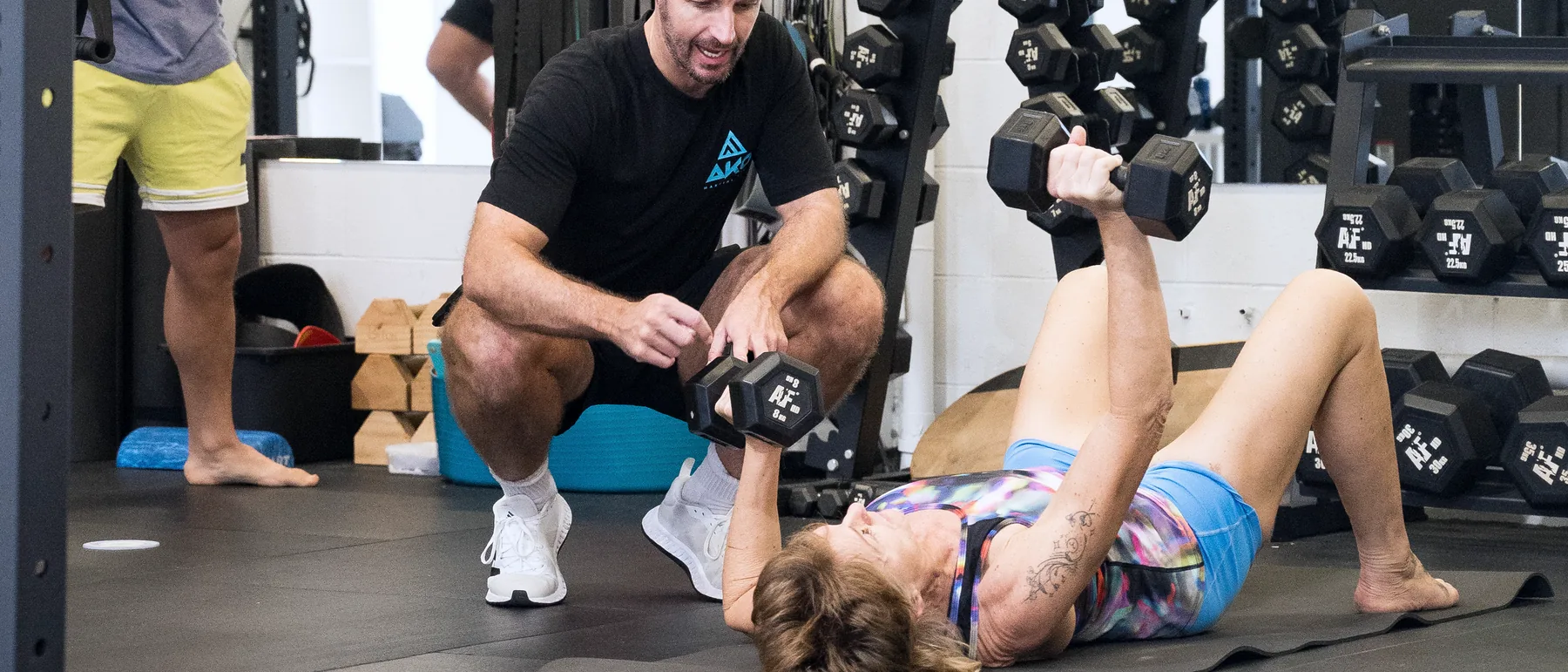
Strength & Conditioning — Monday and Friday 9:30am, Tuesday 6:00am. Coached by Ricky, and coached properly: you'll be cued on form, every rep.
Yoga — Tuesday 5:30pm and Saturday 7:00am. Range of motion, and an hour where nothing is trying to strangle you.
Pick one. Add it to the week you already do. If you're not a member yet, the first week is free and it covers every class on the timetable — the mats and the gym floor both.
- Fitness and strength – strength, movement and yoga, eight sessions a week
- Adults BJJ and grappling – what the strength work is for
- Piranhas, ages 7 to 15 – junior fitness sits inside this one